
Today’s alternative cartographic form, the oblique perspective, is one everybody will recognise. It’s been around for as long as people have been drawing landscapes. My role in the development of this technique has been to provide an academic justification for it.
In the late 1980s I came across an obscure publication by a Scandinavian author, Janos Szego, called ‘Mapping the World of Man’ (sic). In it he conceptualised space-time as a three-dimensional shape. I was immediately aware of the relevance for cartography. I’ve found the most effective way of communicating this concept is to use a can of food from the pantry. Bear with me here! Grab a can and follow along!
OK, hold the can so you can only see the top. It should describe a perfect circle (unless it’s badly dented, in which case throw it away, because those dents can damage the seams and allow bacteria in). See the circle? Let’s call that ‘space’. Imagine it’s a little circular map of the present, focused on your house, like Figure 1:
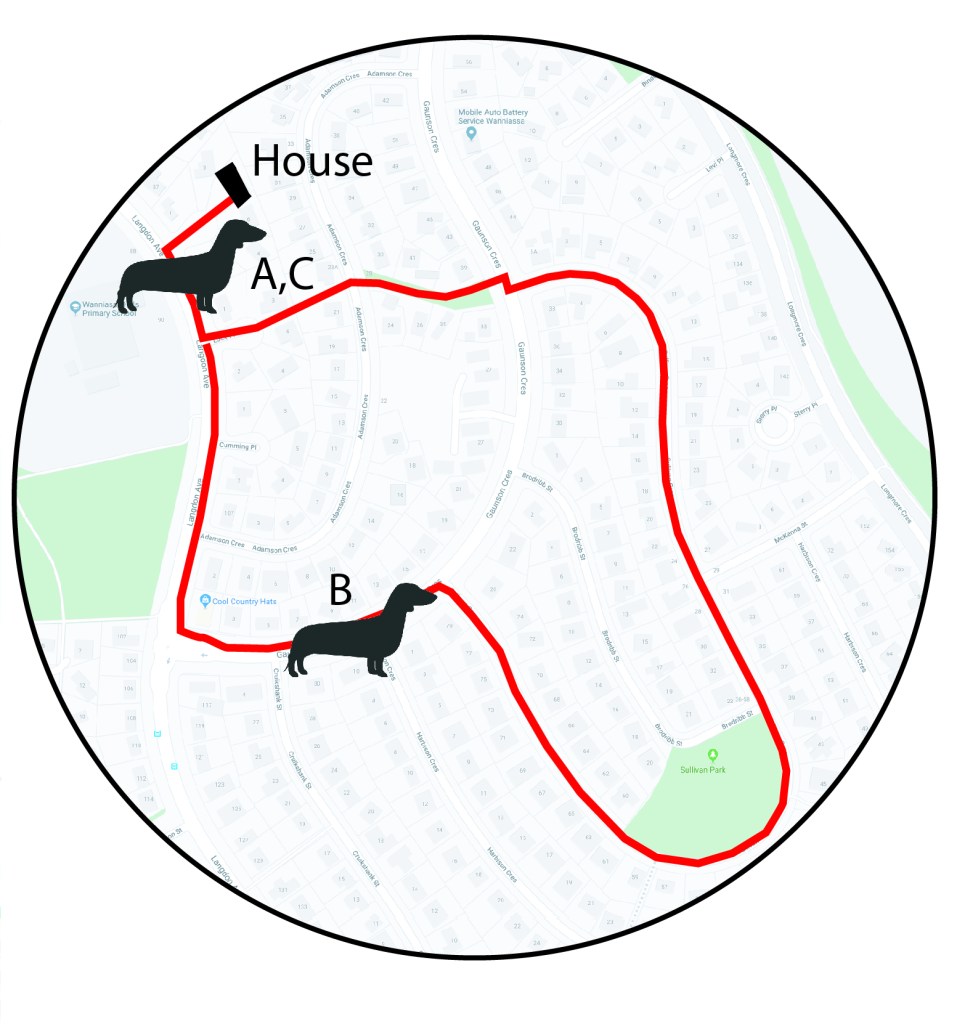
This is actually my dog-walking route, sadly neglected of late. My house is up in the top left of the map. (Coincidentally the route is shaped like a dachshund’s head.) This circle functions like a normal map, with the viewer looking down on the earth with a god’s-eye view. The dachshund silhouette is my dog Rogue, in the same place at the beginning and end of the walk (A and C) but in different locations during the walk (eg B).
Now turn the can so you are looking side-on, like Figure 2. Now you can’t see ‘space’ at all. What you’re seeing is ‘time’ – all the previous spaces stacked on top of each other, from the distant past at the bottom to the present on top. If you could slice horizontally through the can, discard the top part, and then turn the can so you were looking down on the the remains, you would see the ‘space’ but at some point in the past. (Or messy food spilling out.)
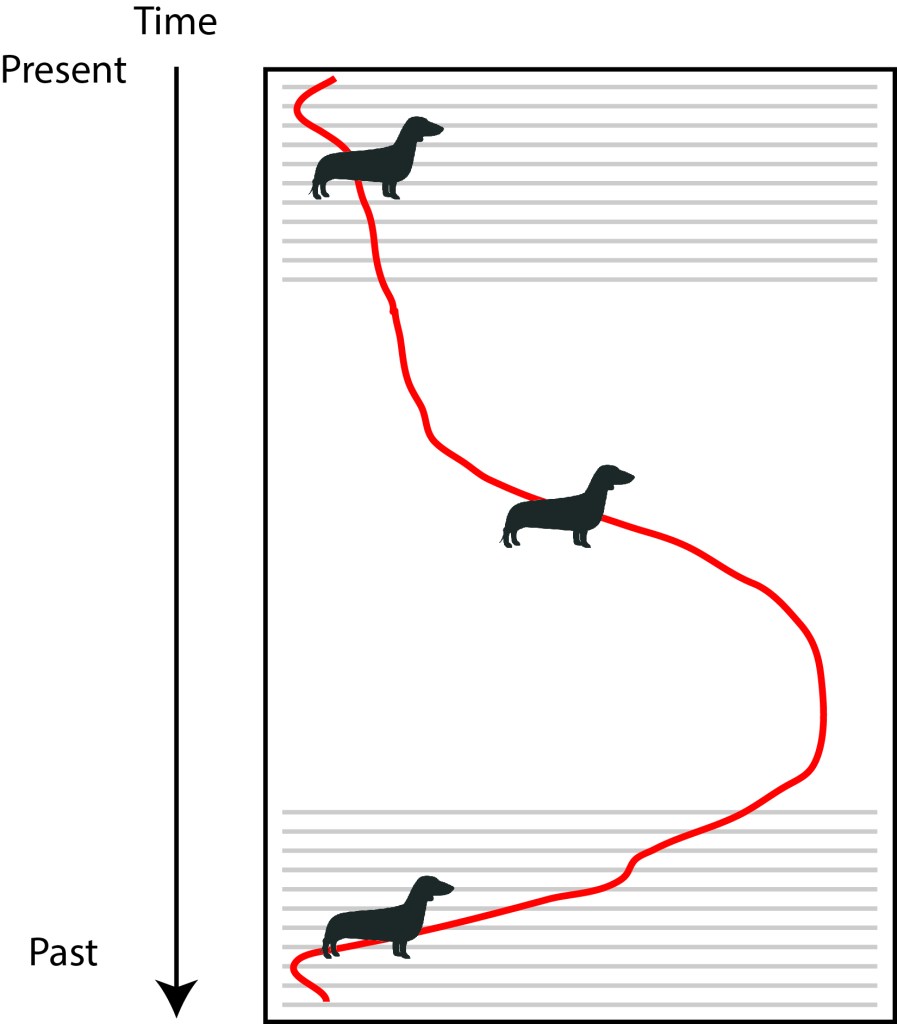
My dog-walk becomes a line through time, from the beginning of the walk at the bottom, to the end of the walk at the top. In this example A and C are at different times, so Rogue appears at the beginning and end of the walk at different places on the can.
Thus the vertical view shows space, and the horizontal view shows time. Now, hold the can at an angle so you can see both the top and the side. You are now viewing an oblique perspective, and you are, in effect, seeing both space and the implication of time. (This is the hard bit to get your head around.) An oblique perspective implies time, and is best used when mapping a journey – like we find in many novels, especially fantasy novels.
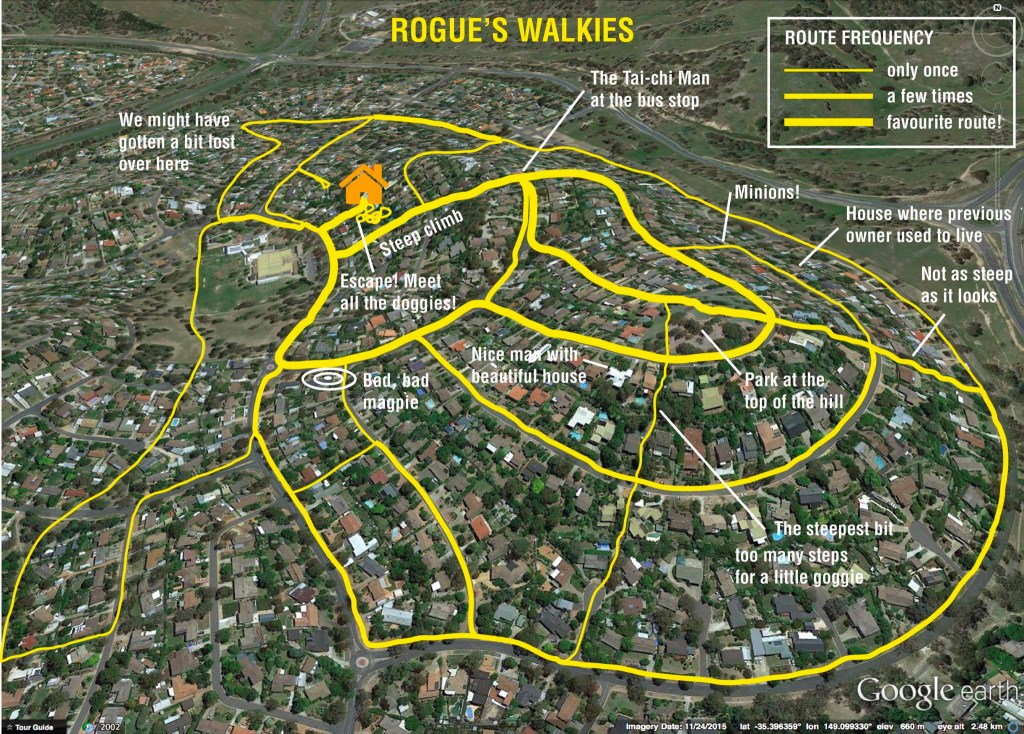
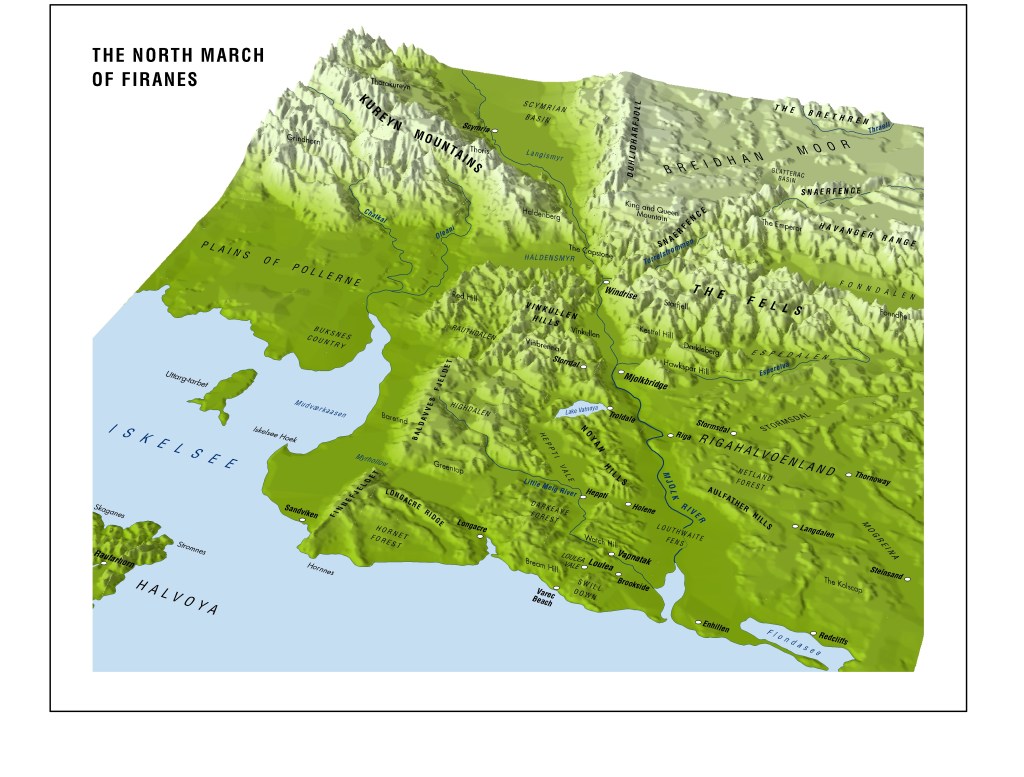
Figure 3 is an oblique perspective I drew a few years ago, showing Rogue’s dog-walking route. To achieve the effect of what Szego calls ‘procedural space’, any formal idea of scale has to be sacrificed, but we gain a sense of time (in that some parts of the map are further from the viewer’s eye than others). This is the principle upon which Satnav displays work: the viewer ‘proceeds’ from the bottom of the map into the map, with the destination in the distance, at the top. That’s an oblique perspective.
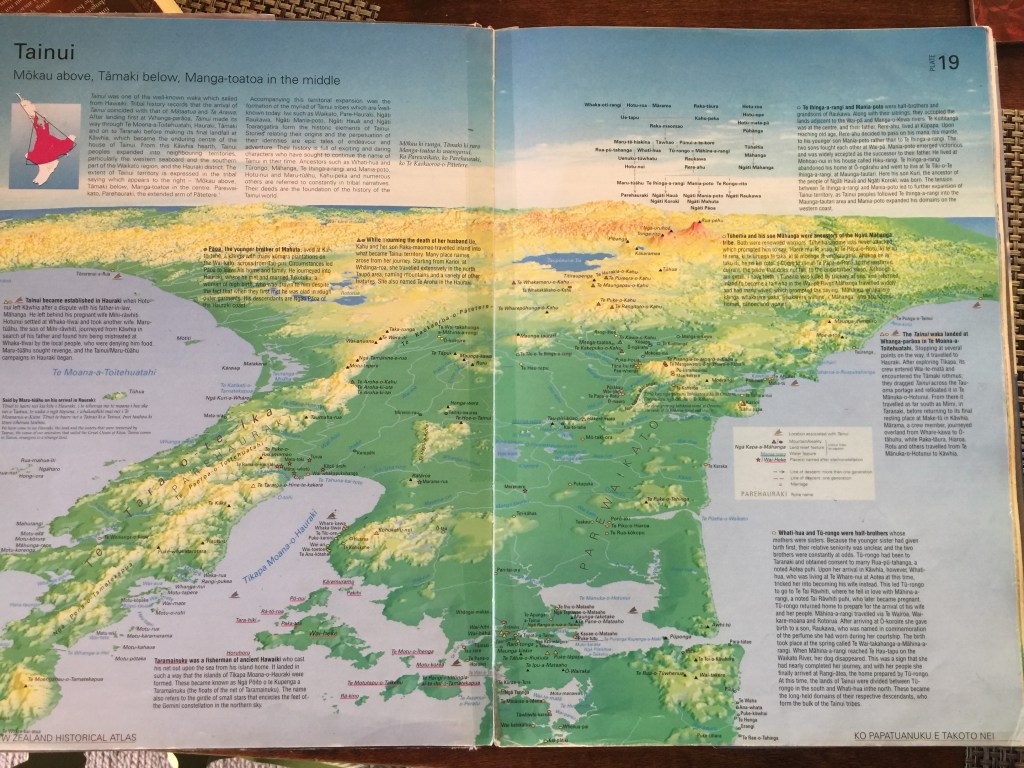
Cool story bro, but is it usable? Well, yes. In the 1998 New Zealand Historical Atlas we faced the challenge of mapping Maori spaces without resorting to formal western top-down, god’s-eye Euclidean space. I came up with the oblique perspective for the maps of Maori spaces, one of which is (poorly) reproduced here as Figure 4. The journeys of Maori ancestral heroes are mapped in detail on a sympathetic projection.
And in fantasy novels? Not so much, though I have used them occasionally. Figure 5 is from my debut Across the Face of the World, inviting the viewer to move from the bottom of the map into the wilderness. Just like a satnav.
Well, that took forever, and I’m not sure if I nailed it. You can put the can down now.
 insanemapboy
Leave a comment