Chekhov’s Gun and Double Duty

Another in my Friday Fiction series highlighting thoughts around writing, focusing on the fantasy genre. This one from the “you already know this” file.

Every writer knows (or should know) the dramatic principle of Chekhov’ Gun. That is, as the playwright Anton Chekhov put it, “If in the first act you have hung a pistol on the wall, then in the following one it should be fired. Otherwise don’t put it there” (Simmons, 1962: 190). Every element in a story must be necessary, and irrelevancies should be removed.

Sounds good, yes? But I mistrust the rigidity of this principle. So-called ‘irrelevancies’ can add colour and backstory to a novel, and even exist for their own sake. Why not? There are no rules for story-telling. As long as the branch spur doesn’t dominate the main line, why not do a little exploring?

That said, Chekhov’s Gun is a good principle to keep in mind. Although I’d alter its intent a little, to something I call the Principle of Double Duty. That is, every element of a story should do two things, not just the obvious thing it’s in the story for at that moment.

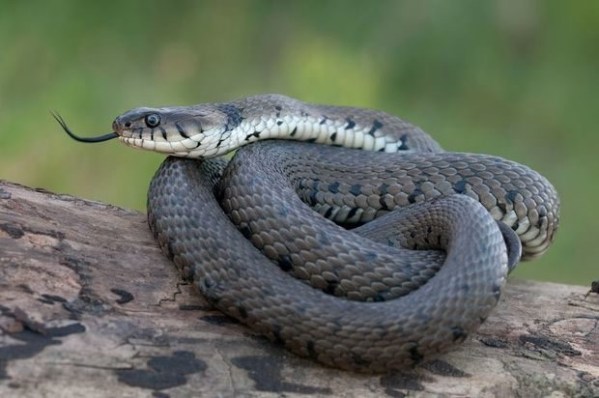
I can illustrate this with reference to J.K. Rowling’s Harry Potter novels. Rowling is superb at Double Duty: the incident when young Harry encounters the Brazilian snake at the zoo, before he knows he’s a wizard, serves to establish his magical power. It’s a delightful little episode both in the book and in the movie. Rowling stores it away and brings it back out in the second novel, when we discover Harry’s ability to talk to snakes (Parseltongue) is uncommon and associated with evil. Harry’s Parseltongue enables him to enter the Chamber of Secrets and leads to his eventual victory over a pseudo-Voldemort.

And there’s Triple-Duty when we discover, many books on, that Harry is a Parseltongue because he’s one of Voldemort’s Horcruxes, imbued with a piece of Voldemort himself – which is why, in order to kill Voldemort, Harry has to die. All foreshadowed by the incident in the zoo back at the beginning of the first book.

This is plotting brilliance, and we should not be afraid to experiment with it as writers. Creating this sort of complexity both echoes the cascade of life and pleases the reader greatly. The Harry Potter books thrill children and adults alike because of their intricate, puzzle-like nature.

Of course, you can’t write like this unless you either plan ahead or have a very strong sense of your story (and a good memory). It’s said that Rowling knew how her series was going to end even as she started. While such meticulous planning can be restrictive, it’s also immensely satisfying to read. Chekhov’s Gun? Don’t know I’d follow it as a hard-and-fast rule. But Double Duty? I try to use this principle whenever I can.
Tianjara Falls

Welcome to Waterfall Wednesday, where I feature wonderful waterfalls while we all watch and wonder. (Sorry, blame Sesame Street and Wanda the witch’s wiry wig for my whimsy.)

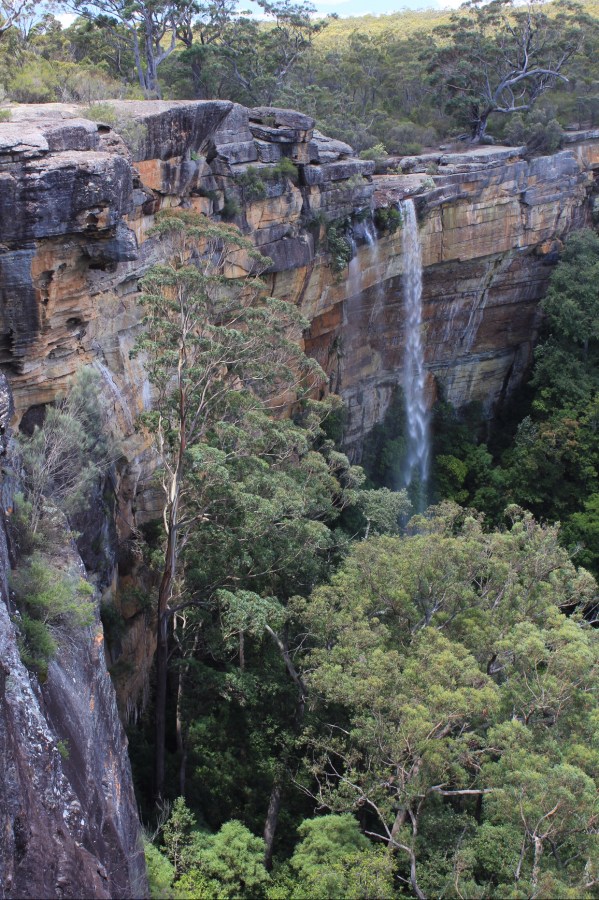
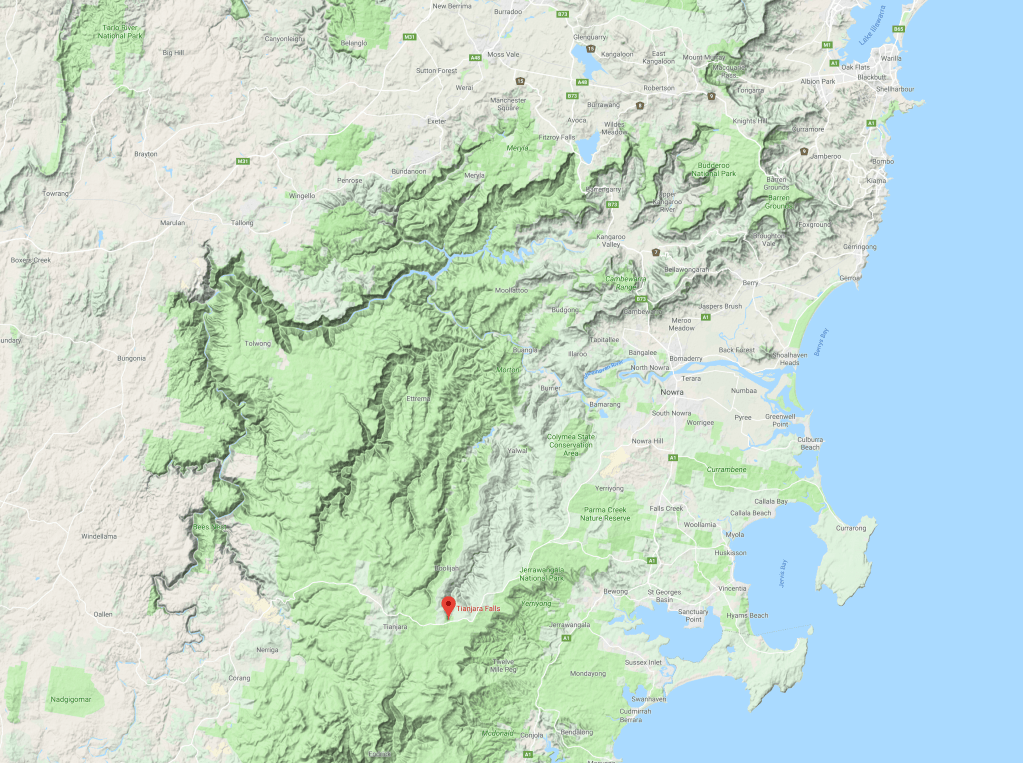
Today’s waterfall is Tianjara Falls, roughly two-thirds of the way to Nowra from Canberra on the scenic but underused Nerriga Road. Originally built as the major connector between the ACT and Jervis Bay – supposedly intended as ACT’s port – the road never really saw much traffic and parts of it remain unsealed. The falls tumble over an escarpment, a ubiquitous feature of Australia’s east coast responsible for many spectacular waterfalls.

The erosion of the escarpment by streams is visible on Google Maps.

I’ve chosen Tianjara Falls so as to illustrate one of the main issues in landscape photography: when to take a photo. Sometimes we turn up at a wonderful location but the light is all wrong, or it’s raining, and the shot is ruined. Nothing you can do about it if the visit is a one-off, but if you have regular access to a place, try to plan your visit.

The waterfall photographer keeps an eye on weather and climate to estimate the amount of water likely to be in the fall. A careful read of a good map is also helpful (Google Earth will do) so as to get a sense of how large the headwaters are. The other eye is firmly focused on the time of day and the aspect of the waterfall, to ensure the shot isn’t compromised by shadows.

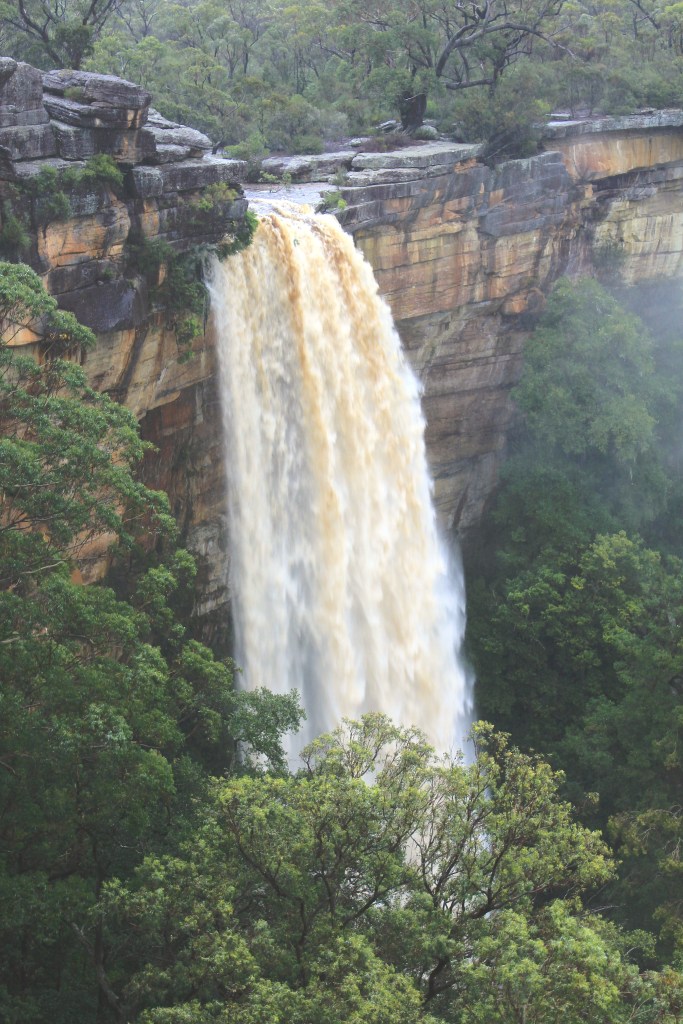
Tianjara Falls has a very small catchment area, so while average annual rainfall is reasonable by Australian standards, there are going to be large parts of the year when the fall is either dry or barely flowing. The ideal would be to visit after a few days of rain, which I did in December 2014, yielding the shot at the beginning of this post. The volume of water compares favourably to the photo accompanying the Wikipedia entry for Tianjara.

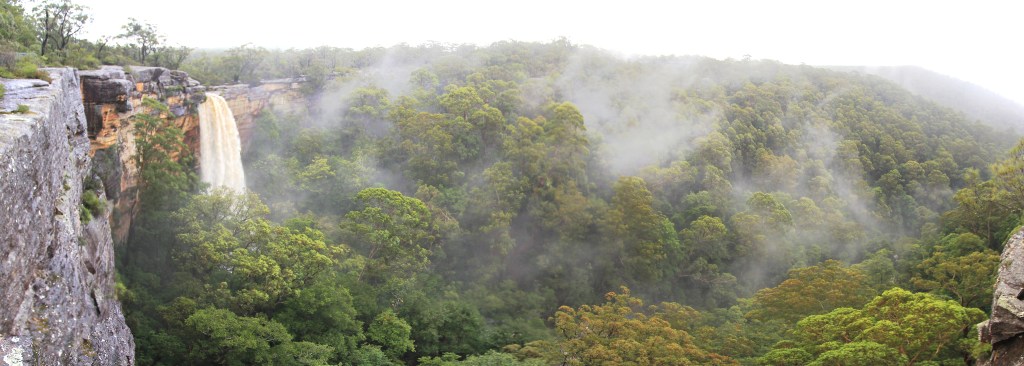
The escarpment area is, however, subject to occasional ferocious storms, and one such storm dumped 250mm of rain in the area in one day. I arrived at Tianjara Falls at the tail end of the storm and joined astonished locals on the viewing platform, one of whom said there hadn’t been this much water in the fall in the 25 years he’d been visiting it. Lucky? I find the more carefully I prepare, the luckier I get.

I am a weasel.

The Dark Side of Topographic Maps

Welcome to the second Monday Maps blog! Last week I featured an example of a topographic map series I produced for my first novel and trilogy. At the time I was writing that trilogy (the late 80s) I was also completing my Ph.D, in which I investigated the social context of mapping. Why, I asked, does western society have the kinds of maps it does?

The answer will surprise no one, though it was fairly revolutionary in the 1980s. Topographic maps are social documents imprinted with colonialist values, both military and economic. They were used to assert the primacy of the physical landscape over any other type of geography, to impose western values on the non-western world, to assess the military potential and limitations of the landscape, and to enhance economic development. They are a conversation between military men and powerful men using cartographers as their translators, and when we read this sort of map we are overhearing a conversation never intended for us. Women are perfectly capable of interpreting maps, but this hyper-masculinist colonialism raises a barrier many do not bother to cross.

How high a barrier can be demonstrated with reference to the words of Col. Thomas H. Holditch, a past president of the Royal Geographical Society, who in 1917 said that:

“The right of the white man to fill the earth and subdue it has always been unquestioned, because it is based on the principle that his [sic] dominance and lordship tend to the betterment of the world.”

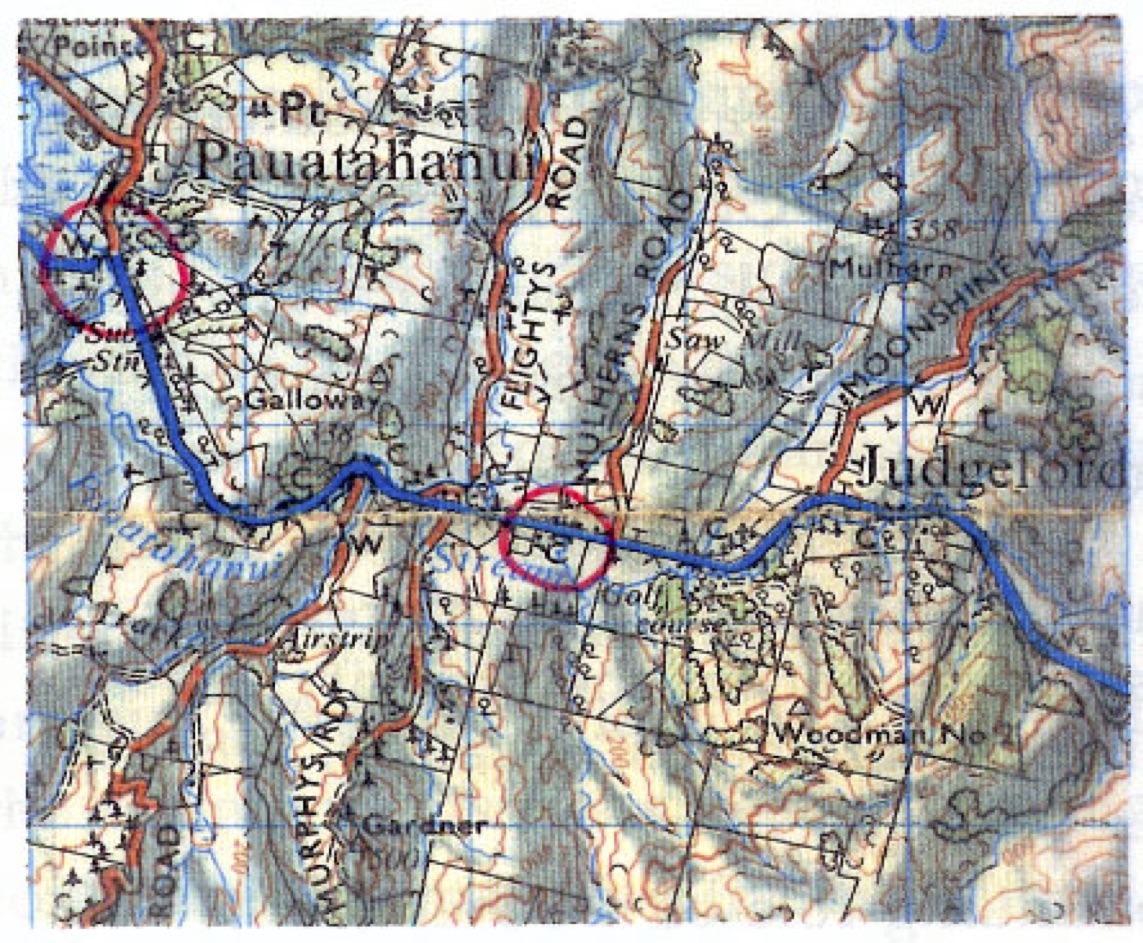
Excerpt from 1:63360 topographic map, New Zealand.

What are the two features marked W and C I’ve circled on this topographic map? Take a moment. (I know I haven’t given you a key.) They’re bridges. One is two-lane, the other is single-lane. What do the letters W and C stand for? Wooden and concrete. So why do we need to know the width and construction of these bridges? Anyone? Because the ability to move ordnance around depends on such knowledge.

The key to understanding topographic maps is to recognise they are military documents. In the UK they are produced by the Ordnance Survey. Historically the chief surveyor had a rank in the military, often the surveyor-general.

Topographic maps are used as the base maps for most other mapping types. Humanity has spent millions of hours and billions of dollars making them. They have, unsubtly, remade the way we see reality. The central challenge of my academic career was to try to imagine what sort of maps we’d have – and what sort of societies we’d have – if westerners had gone with human-centered rather than empirical knowledge as their philosophical foundation… which is where fantasy maps come in. Or they should do. But that’s for another post.

Polite Fictions

The first of a Friday Fiction series highlighting thoughts around writing, focusing on the fantasy genre.

A ‘polite fiction’ is a situation where we all see an awkward truth but we ignore it to save confusion or embarrassment. There are many polite fictions in, well, fiction.

For example, when writing or reading fiction we pretend it’s normal to be hearing people’s thoughts. Close third person point of view presents the fiction of hearing the character’s thoughts as though we are them. In novels with more than one point of view we are faced with believing we can hear the thoughts of multiple people. There are informal rules writers use to help the reader do this, but it’s still a polite fiction.

Characters’ thoughts are written far more coherently than they think them. (Or would have thought them, had they been real.) Our thoughts are a messy combination of images, memories and words, and rarely form anything approaching sentences. Yet we seldom realise that an internal monologue is a polite fiction.

This is also true of dialogue. When we talk to each other our dialogue is full of false starts, filler, stuttering, repetition, incomplete sentences, talking over each other, pauses, laughter, noise and non-verbal language. Somehow our written dialogue has to convey the rich layers of meaning in real conversation without all the messy extras. Instead of reporting verbatim:

            “… I mean… there’s no… I can’t explain what I was, ah, what was going on,” [points to her head, sniffs] “it’s like…”

            [Raises eyebrows] “You must have some, some sort of idea, surely?”

“… I was zoned, um, spaced out, cos of, did I tell you, like, I didn’t sleep…”

“Yes, you did, god!”

“… last night?” Laughter. “Oh, um, sorry.”

we write:

“I can’t explain what was going on in my head,” she said, rubbing at her nose.

“You must have some idea, surely?”

“I zoned out because I’m tired. Did I tell you I didn’t sleep last night?”

He laughed. “Yes, you did.”

“Oh. Sorry.”

This convention is extended to the language itself. Most novels sold in the western world are printed in English, even though in many cases the language being spoken by the characters is not. This is particularly true of secondary world fantasy, where the possibility that the characters would converse in actual 21st century English is vanishingly remote. (It’s also highly unlikely any far future conversation will be in recognisable English, given how rapidly language evolves, and the probability that western hegemony will have been upset by then.)

We accept the fiction that the story is being TOLD, not recorded. It has undergone transcription, translation and finessing to end up in the novel on our laps. Even this is a polite fiction: really it came from the novelist’s mind. But because we want to immerse ourselves in an alternate reality we imagine all these processes have occurred – when we think of them.

A couple of interesting points follow. First, recently we’ve seen a reaction among readers and writers against faux-medieval fantasy. The ‘faux’ is the polite fiction, an amalgam of cliche, convention and assumption (often accompanied by borderline racism) that made the novels easier to read. As our genre becomes more diverse we shed a number of these built-in short-cuts. We are challenged by different words, different artefacts and different dialogue. Our genre becomes exciting again.

Second, what about semi-textual accompanying material? Chief among this is the map: many secondary world fantasies have maps, and virtually none of them are drawn in the way the world in question would have produced them. There’s a general Tolkien-derived map style – Ye Olde Fantasy – that readers accept, doing the same mental gymnastics they do with the actual text. They are generally much simpler and easier to read than genuine historical maps, for the same reason dialogue is simpler than recorded speech. But just like speech, some of the richness is lost. And, just like the novel itself, it is past time the map because more diverse. More of our polite fictions need to go.

Falthan Topographic Map

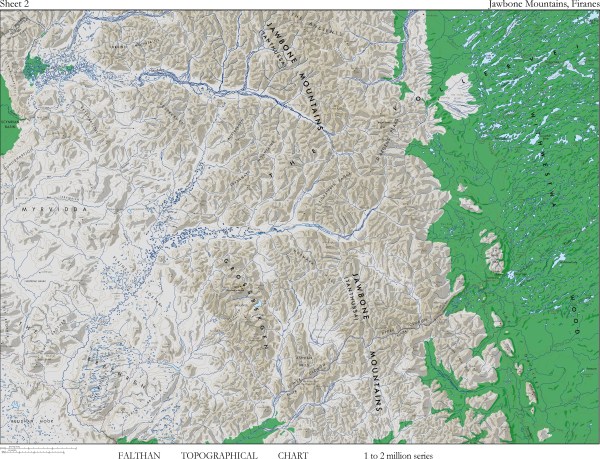
This map is one of a series of maps I made for my original fantasy trilogy, Fire of Heaven. I began writing in 1986 and spent most of 1987 making maps for the continent of Faltha. These I scanned and redrew in the late 1990s using FreeHand for Macintosh.

What is interesting about this is the inner tension they reflect. They have a topographic map style, a format I had critiqued during my Ph.D. Topographic maps reflect the priorities of the military, with their choice of features determined by the requirements of war. (I’ll have more to say about topographic mapping another time.) This is not the kind of map I wished to shape my fantasy world.

Yet topographic maps powered my own imagination. Coming from a background of relative poverty I did not travel as much as I would have liked, so as a child I used these maps to project my imagination around the world. I collected topographic maps and mind-travelled up their deep valleys, over their tall mountains and across their expansive plains. Looking back it was only natural that the twenty-five year old Russell would map his fantasy world using these devices.

However, I largely kept them out of my novels. By the time the novels were published, beginning in the early 2000s, I had developed other methods of cartographic representation. More on them later.

The Fantasy Map project

It’s one year until IFWG publishes my next novel. In those 52 weeks I intend to outline what I see as the past, present and future of fantasy cartography, with examples from my own and others’ work.

I will post one map per week for those 52 weeks, along with discussion and analysis. I am hopeful some of these ideas might be useful – or, at least, thought provoking.

My First Blog Post

Welcome! I am a writer, a cartographer and a photographer. With six best-selling fantasy novels and a similar number of award-winning atlases, I am sure I can entertain you. There’ll be something new every week, so remember to check back often.

Blog at WordPress.com.

Up ↑