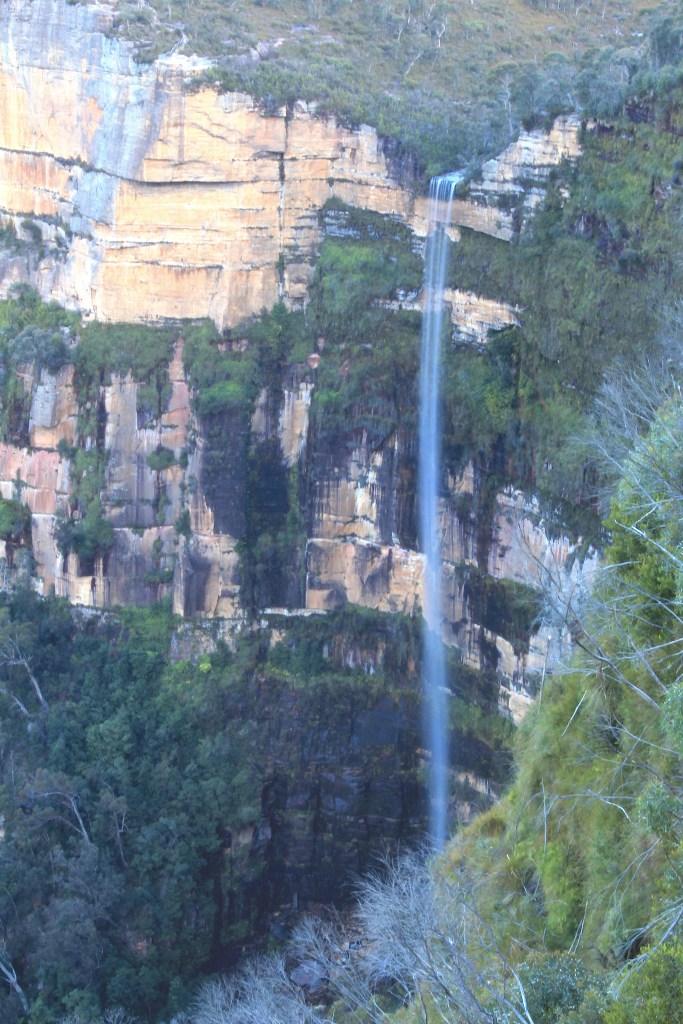
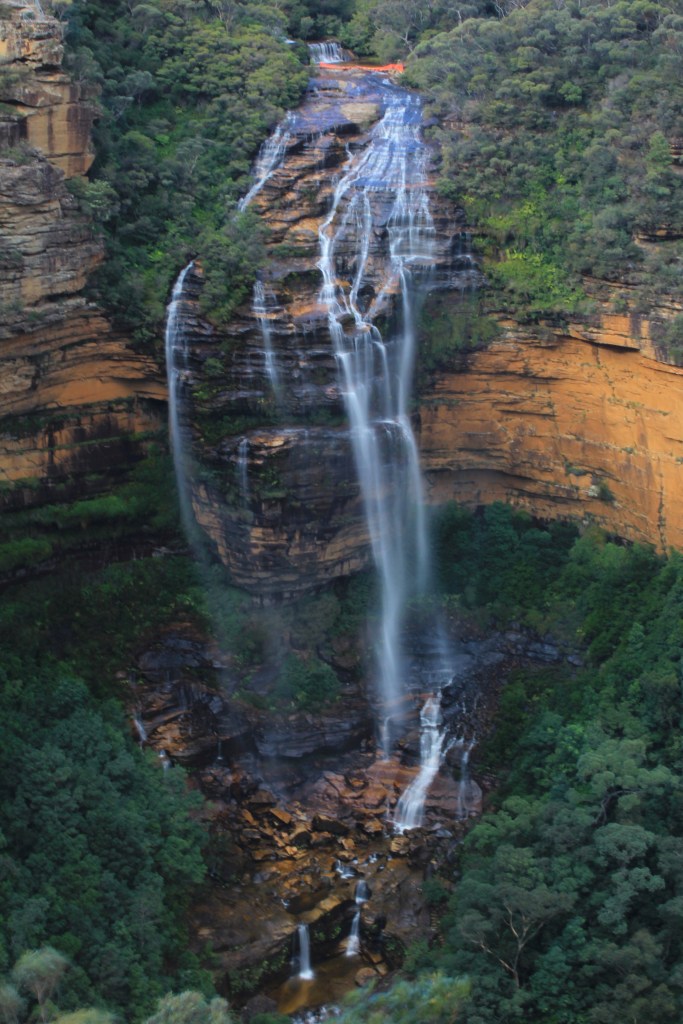
The final Blue Mountains waterfall I’ll feature on Waterfall Wednesday is Govett’s Leap Falls. It’s a 180m single-drop that falls over Taylor Wall into the Grose Valley on the far side of the main plateau from the other waterfalls in the area.
Govett’s Leap Falls from the main lookout.
It’s a pretty enough waterfall, though it often has little water and in times of drought dries up completely. However, waterfall or no, the viewpoint is worth a visit. The superb Blue Mountains Heritage Centre is on the road to Govett’s Leap, and after you’ve visited the centre you can spend hours at the viewpoint watching the glorious vista change before your eyes, depending on the angle of the sun, the quality of the light and the season of the year.
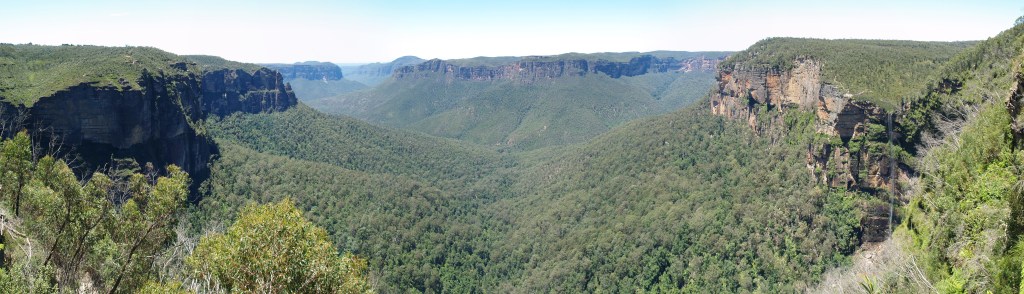
The first time I visited the viewpoint, on a bright afternoon, the fall was barely flowing. I did not venture down the trail to the base of the falls, believing I would return another day. A mistake.
The Grose Valley from Govett’s Leap lookout on a sunny afternoon.
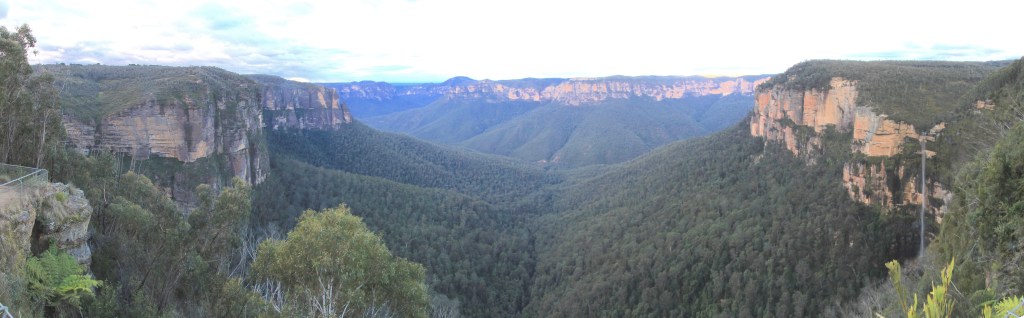
I returned to the viewpoint a year or so later on an overcast day to discover the trail closed and the area swarming with police. That afternoon I learned about the rather sad history of Govett’s Leap. A person had jumped to their death earlier in the day and police were searching for the body, rappelling/abseiling down the side of the cliff. Talking with them, I found an interesting mix of compassion and anger. Some bemoaned the person-hours involved in this work, while others found it in themselves to empathise.
Light makes all the difference.
And yes, I took a couple of photos, because the water was flowing and the light was so bewitchingly different. But I’ve never been to the base of the falls.
As I’ve said before, even the standard cartography in my upcoming novel Silent Sorrow (IFWG, 2020) will be integrated into the text, carrying the weight of the storytelling. The maps are artefacts, meant to look like they were drawn at the time, each by different hands.
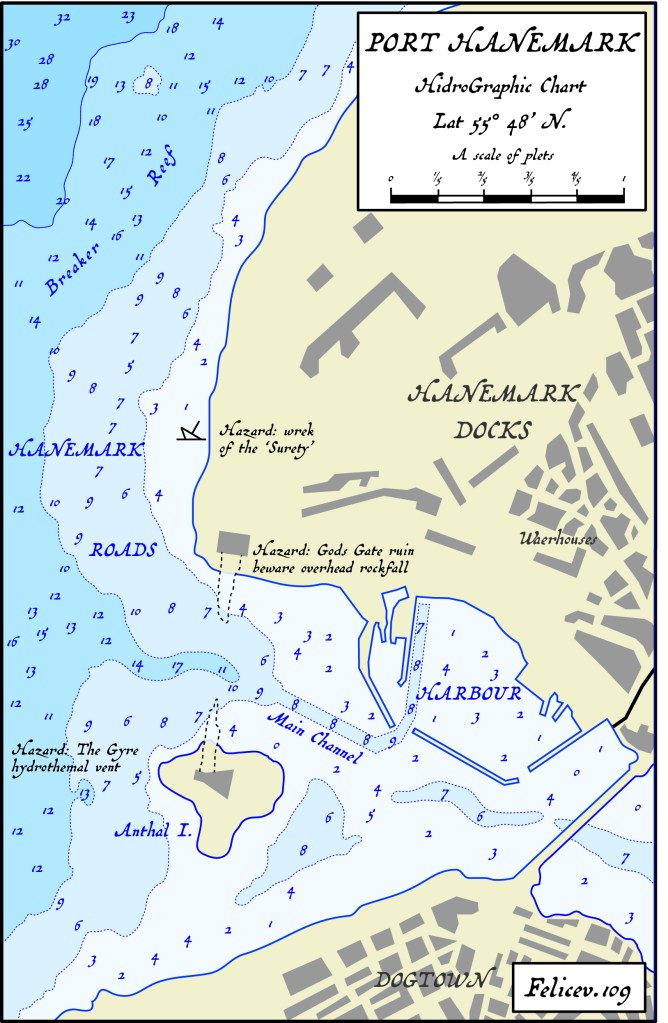
This map has a particular history, and is the reason Remezov took apprenticeship with his master, Felicev. Remember that in this extremely unstable world geographers are necessary, well respected and rich (unlike here)…
The map here does double duty. First, it shows that the young Remezov’s boastfulness isn’t illusory; he is indeed an excellent cartographer with good instincts. And second, it is useful for the scene in which it is embedded, set at the Hanemark Docks.
Here’s an excerpt from the novel, with the accompanying map.
…Just Felicev being his curmudgeonly self. Oddly, it was when the old fool was at his most contrary that Remezov felt fondest towards him. It had been that way since the day they’d met.
Alone in a strange city and desperate for money, an eleven-year-old Remezov had fashioned a scheme to forge maps and sell them as genuine in the Xallis Market. This had worked well until a wet afternoon when he’d been accosted by two men.
‘These are quite good,’ one had said, and called over a thickset companion. ‘Ho, Felicev! Your spelling is execrable!’
‘But my handwork is much steadier,’ said the second man, snatching up a map of Sarella. ‘So, young fellow, who draws these?’
‘I draw them,’ Remezov had said, working through the men’s comments and readying himself for a beating or worse.
‘No point in protecting your master,’ the first man had said. ‘We’ll find her eventually.’ He turned to his genial companion. ‘It’ll be a her; linework’s too fine for a male hand.’
‘Yours?’ the big man said, ignoring his
companion.
‘Not even my best,’ Remezov had said, stung. ‘Look at this one. Sea chart, Hanemark Roads.’ An unnecessary detail, he realised, as he unfolded it. ‘I thinned the lineweight, added a wash to make the ocean stand out and used less elaborate lettering so people could actually read it. Looks much better.’
‘Using a Jonpan wash to emphasise the
hydrography does make the information pop,’ the first man had said, nodding at
Remezov.
‘Good instincts,’ said the genial man. ‘What
are you, fifteen?’
‘Eleven, and already better than you. I’ll be better still by fifteen.’
It made the man laugh. ‘Ah, arrogance, the geographer’s one essential quality. Come with me.’ He’d clamped a hand on Remezov’s shoulder and dragged him away from the market and his painstakingly-drawn maps, and changed his life forever.
Silly old fool. Glorious bastard. Impossible
madman.
Listening to the ABC on the way home today, I caught an interesting feature about a recent research report. Apparently researchers from someplace (probably Scandinavia) worked out that people react most positively to music that has a combination of expected and surprise elements. I’m not an expert on musical composition, but that made sense, and I recognised a pattern I’ve also seen in writing.
First, the expected. When I was working on the New Zealand Historical Atlas in the 1990s we often talked about the ‘Jock Factor’, named after a historian who acted as an advisor to the project. We wanted to subvert everything, and he kept telling us that we had to give the readers what they expected. ‘You gotta put Captain Cook in there!’ (We didn’t want to, but we compromised and produced a plate entitled ‘On the Margins’ in which he barely features.) So now, whenever I hear this kind of advice, I think of Jock. Yeah, Jock, I guess we have to give people at least some of what they expect. Or, more accurately, we have to give them most of what we set up. If I position two armies opposite each other, I’d better provide the readers a battle. If the love interests finally meet and the sun’s setting behind them, they’d better kiss. Readers don’t like it when you withhold the payoff.
Stolen from Reddit, couldn’t find attribution
Or I can do something unexpected, but it had better be good. These are the memorable new moments in pop music, the Beatlesque moments that saved them from being another formulaic rock and roll band. The opening chord of ‘A Hard Day’s Night’, the piccolo trumpet solo in “Penny Lane’, the last four minutes of ‘Hey Jude’. And not just the Beatles, of course: I just have to say ‘I see a little silhouetto of a man’ and you’re remembering the most left-field, unexpected diversion in all of #1 singles history. More than just a plot twist, these are moments that take the narrative or character in an unexpected but satisfying direction. And they are very hard to do when writing a novel, for the following reason…
…most novels
aren’t written by people at all. They’re written by the genre. Every time I sit
down to write the memories of the two thousand books I’ve read dictate the next
line to me, or the next plot development, or the next character. They mitigate
against the unexpected and turn our work, no matter how original the idea, into
a pastiche of what we’ve read. I’ve worked hard to get into the habit of
rejecting the first sentence my brain comes up with. And the second. Or, if I
need to make progress, writing it down on the understanding it must be
replaced. Damn it, I’m writing this book, not the genre. Get out of my head!
How about
this, then. Creative tension is the balance between comfort and originality,
between the expected and the surprising. Staying on the leading edge of this
tension takes effort, and is one of the main reasons writing is hard.
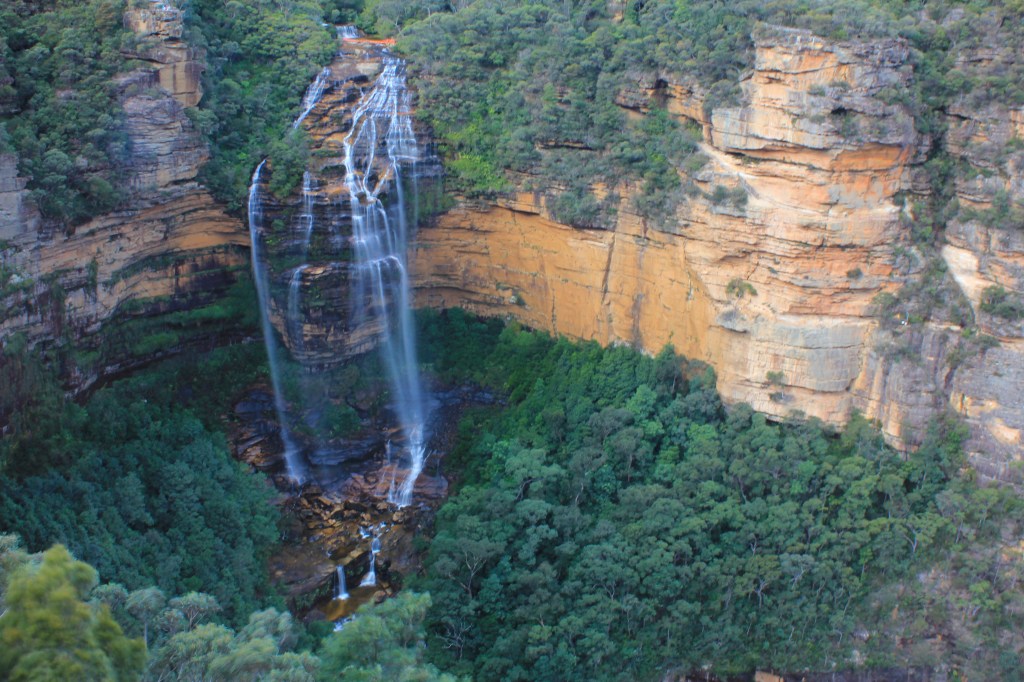
The largest waterfall in the Blue Mountains of Australia, Wentworth Falls is 187m tall. The waterfall is divided into three tiers, with the upper tier the most prominent. It’s by no means the region’s most attractive waterfall, with the main cascade separated by a tumourous bulge in the rock of the escarpment.
Wentworth Falls from Wentworth Falls track lookout
It’s easy to get to, as the stream rises in the town of Wentworth Falls and flows south to the escarpment, meaning you can park very close to the major viewpoints. To get to the base, however, requires a long, steep walk with the promise of the uphill return. I’ve not done this walk yet, and so my views of the falls are limited to the top of the escarpment. It’s likely that the perspective from the base would improve my opinion of the falls.
The escarpment walls are much higher in this area of the Blue Mountains.
Under normal flow conditions the fall looks undernourished, as it spreads out around the bulge; but I’ve seen photos of the falls in flood and it’s spectacular.
Wentworth Falls is less than 10km by road from Katoomba Falls and all the Blue Mountains falls I’ve featured so far could be visited in a single day. Why would you, though? Take your time and work your way around this magnificent part of Australia.
My upcoming novel, Silent Sorrow (to be published by IFWG next year) features a number of maps based on the cartographic ideas I’ve been discussing the past few weeks. I’m writing a long story based on a secondary fantasy world, one not directly inspired by any particular earth culture, and so I am free to visualise the cartography any way I want.
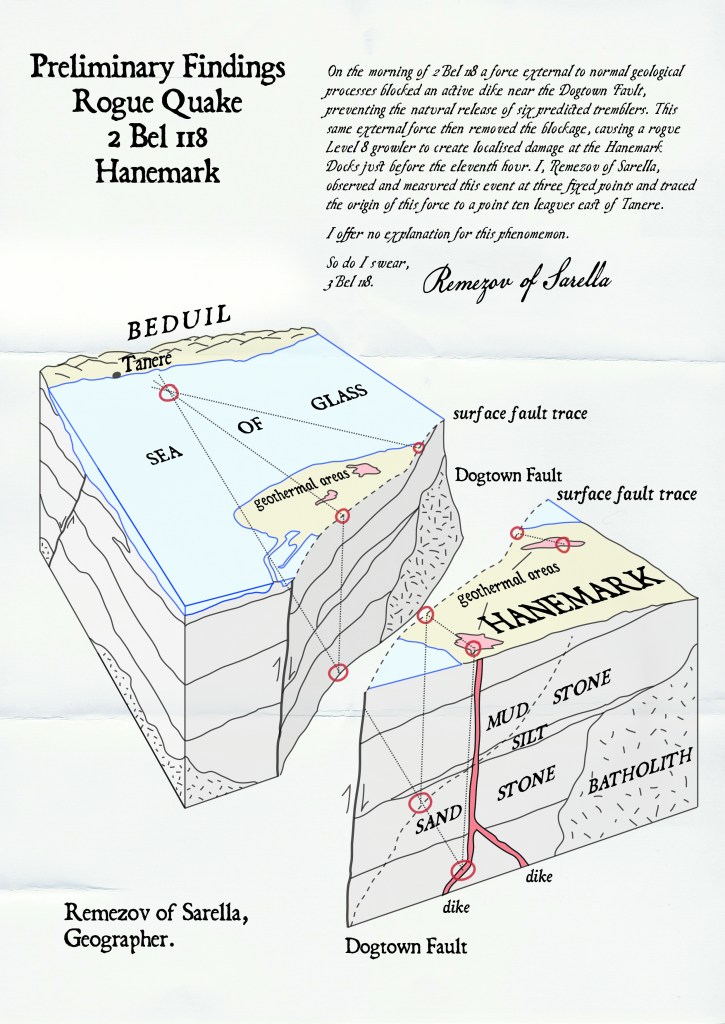
The world of Silent Sorrow is seismically extremely active. Therefore geographers, trained to forecast earthquakes and map their consequences, are in high demand. Remezov of Sarella is one such, and he experiences a rogue (unpredicted) quake in a city he’s visiting. He writes a brief report on the spot for the Guild and accompanies it with a map, as featured here.
The diagram he produces relies on the oblique perspectives theory I discussed a couple of weeks ago. It allows the reader to see in three dimensions rather than the normal cartographic two, but at the expense of a fixed perspective. He chooses to orient the perspective with the source of the quake in the distance, implying direction, travel and a sense of elapsed time as the quake arrives in Hanemark. These ideas are all in accordance with the notion of an oblique perspective. The cutaway geological information adds an extra layer of information to the map.
The result is quite unlike anything in fantasy literature (that I am aware of, at least). It is a ‘found’ artefact, itself part of the story, in appearance just as Remezov would have drawn it – not simplified or ‘historicised’ for the reader. The effect is enhanced by the use of a paper background, as though the map was drawn on a scrap of paper and folded up. It adds vital information to the story while also reinforcing the world of the novel.
Katoomba Falls is in the heart of the Blue Mountains. For those who don’t know this delightful area of New South Wales, it is an hour or so west of Sydney by car or train. They’re not mountains, of course; Australia doesn’t really have what the rest of the world knows as mountains. Sorry but it’s true. They’re actually an eroded plateau. The westward settlement of New South Wales was held up for many years as explorers couldn’t find their way through dead end, sheer-sided valleys – until someone finally figured out you could just walk over the uneroded caprock.
The settlement of the area led to the strange geographical quirk where all the towns are on top of the plateau, and the wild lands are below. It’s rather counter-intuitive until you get used to it.
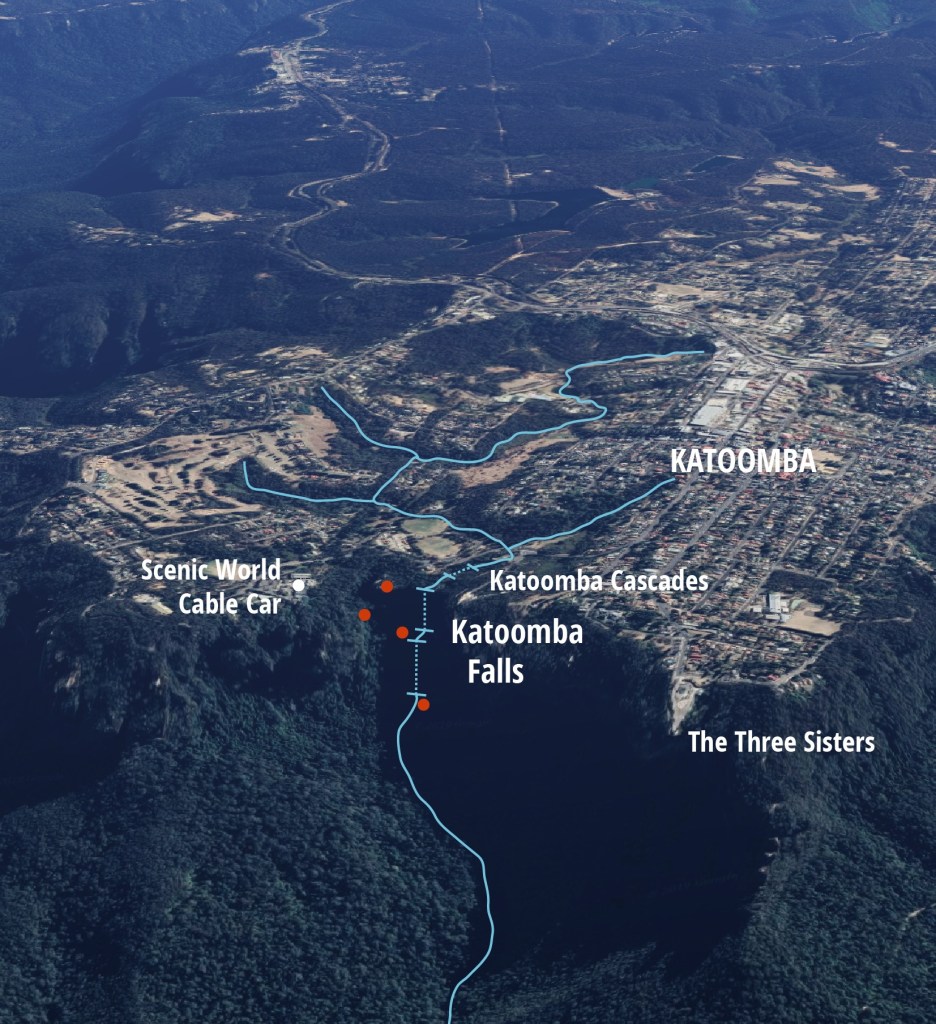
An oblique perspective of Katoomba, centred on Katoomba Falls.
Katoomba
Falls is one of the eastern escarpment’s major waterfalls. It drains from a
small catchment in and around the town of Katoomba and tumbles in two leaps directly
over the escarpment wall into the deep forest below. You can view it at many
points: from above, from various points on the way down and from below – and,
as a bonus, from a cable car.
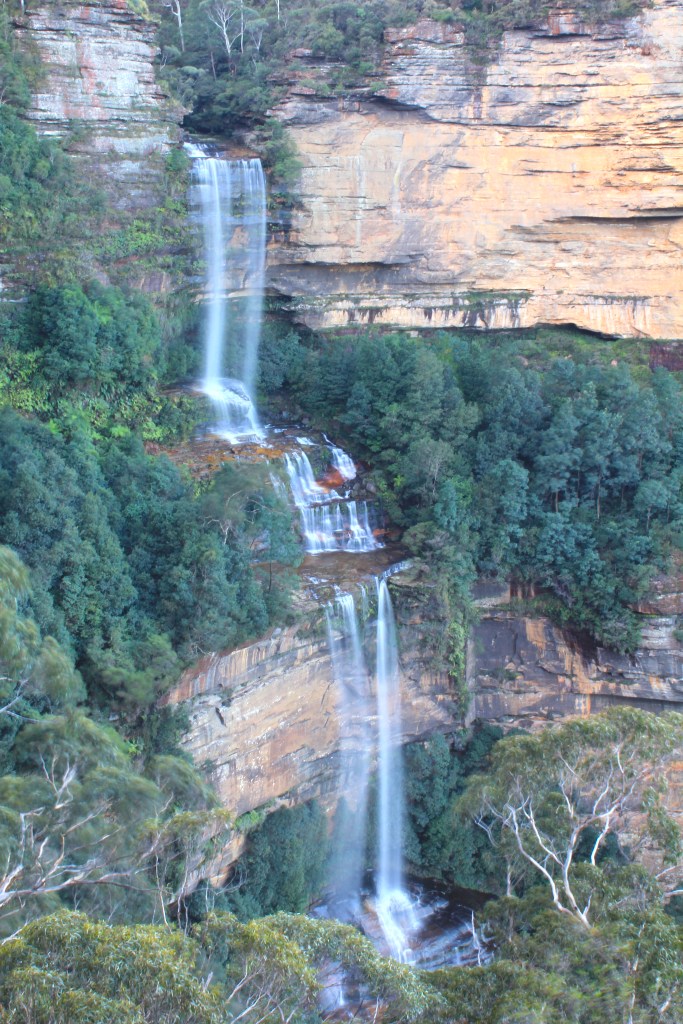
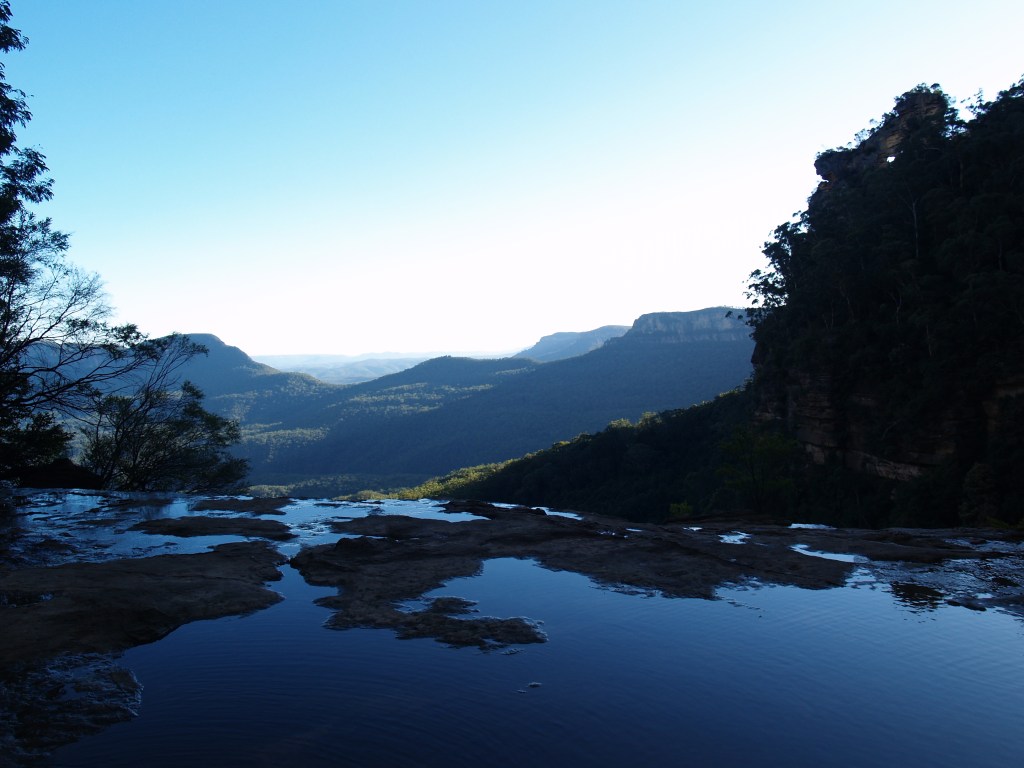
Katoomba Falls is multi-tiered. This view from the upper viewpoint.Note the ledge above the lowest tier.Looking out over Jamison Valley towards Mt Solitary at sunset from the ledge above the lowest tierof the falls.Katoomba Falls from the Scenic World cable carThe falls from the bottom viewpoint
Another bonus: it’s just down the road from the Three Sisters, the Blue Mountains’ premier attraction. In fact, from one vantage point it’s possible to get both in the one photo. It’s also only a short distance from the Valley of the Waters, which we have been featuring these last few weeks. Because these waterfalls drain small catchments they are very vulnerable to low flow. That said, of the three tall waterfalls in the area – Katoomba, Wentworth and Govett – Katoomba Falls probably has the best flow. Go after rain if you can.
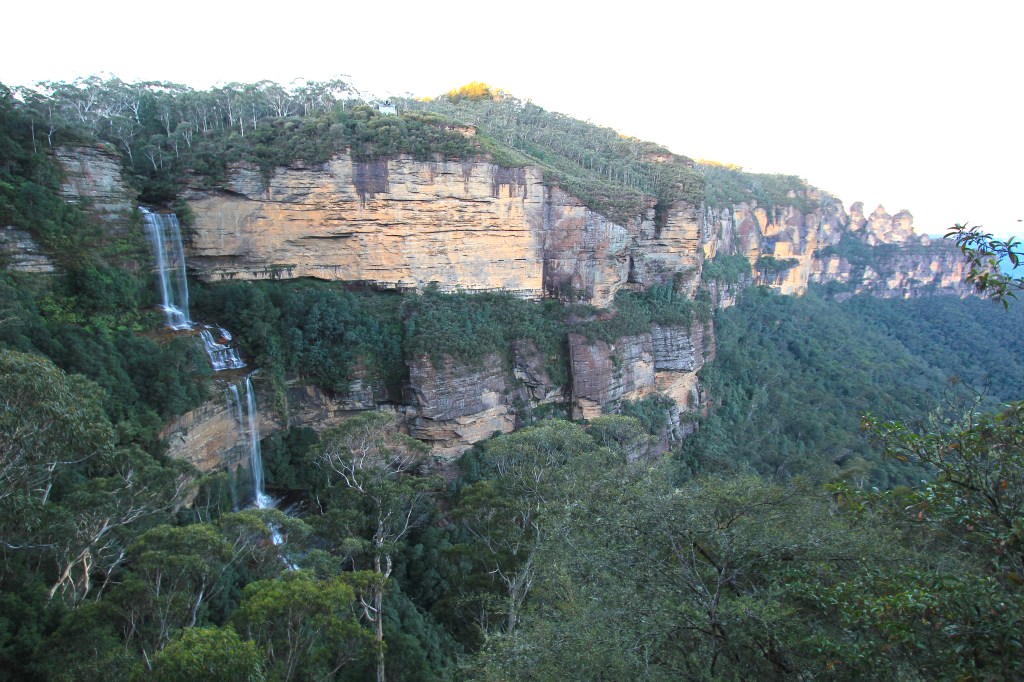
The falls, the escarpment and the Three Sisters to the right
Katoomba Falls is in the heart of the Blue Mountains. For those who don’t know this delightful area of New South Wales, it is an hour or so west of Sydney by car or train. They’re not mountains, of course; Australia doesn’t really have what the rest of the world knows as mountains. Sorry but it’s true. They’re actually an eroded plateau. The westward settlement of New South Wales was held up for many years as explorers couldn’t find their way through dead end, sheer-sided valleys – until someone finally figured out you could just walk over the uneroded caprock.
The settlement of the area led to the strange geographical quirk where all the towns are on top of the plateau, and the wild lands are below. It’s rather counter-intuitive until you get used to it.
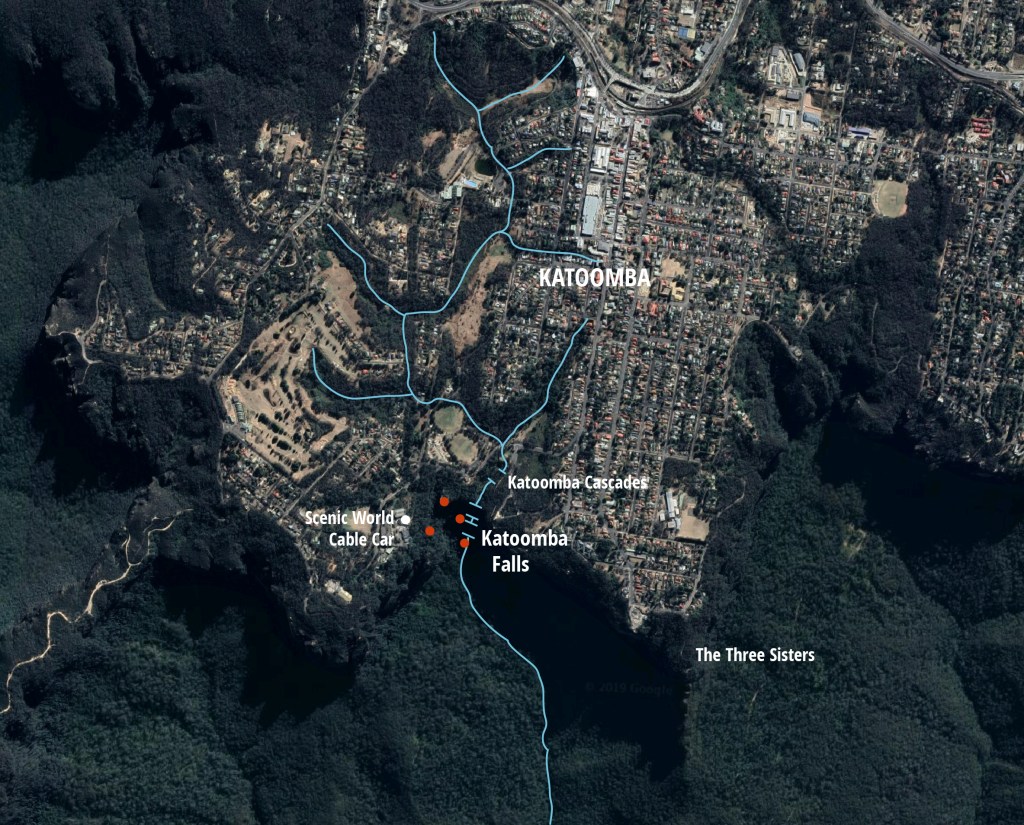
Satellite Image showing location of Katoomba Falls and viewpoints (red dots)
Katoomba
Falls is one of the eastern escarpment’s major waterfalls. It drains from a
small catchment in and around the town of Katoomba and tumbles in two leaps directly
over the escarpment wall into the deep forest below. You can view it at many
points: from above, from various points on the way down and from below – and,
as a bonus, from a cable car.
Katoomba Falls is multi-tiered. This view from the upper viewpoint.Note the ledge above the lowest tier.Looking out over Jamison Valley towards Mt Solitary at sunset from the ledge above the lowest tierof the falls.Katoomba Falls from the Scenic World cable carThe falls from the bottom viewpoint
Another bonus: it’s just down the road from the Three Sisters, the Blue Mountains’ premier attraction. In fact, from one vantage point it’s possible to get both in the one photo. It’s also only a short distance from the Valley of the Waters, which we have been featuring these last few weeks. Because these waterfalls drain small catchments they are very vulnerable to low flow. That said, of the three tall waterfalls in the area – Katoomba, Wentworth and Govett – Katoomba Falls probably has the best flow. Go after rain if you can.
The falls, the escarpment and the Three Sisters to the right
What’s more
important to producing art: the idea or its execution?
First, I don’t think it’s the sort of question that has a definitive answer. Nor do I think the answer matters, but the discussion does. I encountered this question most recently while talking to university students tasked with making creative responses to a gender and sexuality unit. They have to produce art (story, podcast, video, painting, whatever) based on one aspect of the unit, something that stimulated their imagination via fear, horror or disgust, something confrontational or affirming or joyous. A few students are struggling to come to terms with the exercise. They want clarity, given it’s worth 40% of their grade.
Well, I tell them, there’s a limit to the clarity I can give them. There’s no wrong answer to art, nor is there a right answer. There’s only the idea and its execution. The idea: that leap of the imagination sharpening an aspect of the background noise of our life into something that slashes at us, drawing blood. If the unit is about global environmental futures and you’re from rural Australia, concerned about how food stocks are going to diminish over the next generation, how do you bring that to our attention? Gather ingredients you imagine will still be available in 2050 and cook a meal. BAM. Art.
Does it matter how well the meal is cooked? I don’t think so. In this example the idea is everything.
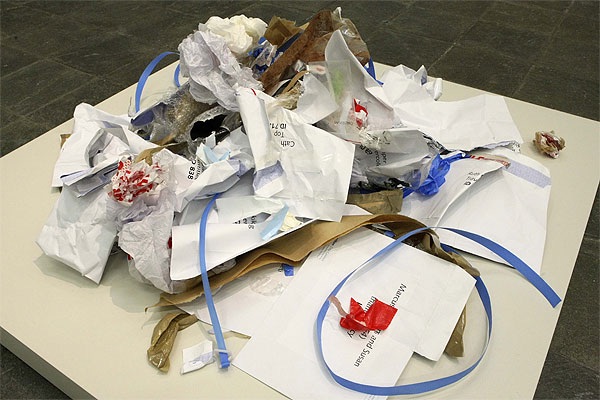
I’m reminded of the National Contemporary Art Award held annually in Hamilton, New Zealand. In 2009 the winning entrant – wait for it – was called Collateral, and consisted of a small list of instructions from an artist based in Berlin asking the museum staff to assemble the discarded wrappings from the other entries. You can read about it here: http://www.stuff.co.nz/entertainment/2857424/Artist-defends-his-award-winning-rubbish
“The form was very secondary to the
idea,” he said. No kidding.
Collateral, by Dane Mitchell, winner of the 2009 National Contemporary Art award
Of course, for every powerful idea without execution, there are a hundred art ideas with painstaking effort put into their realisation. And sometimes the detail in the execution obscures the idea.
The balance is somewhat different with a movie or a novel. The idea is akin to the log line or the elevator pitch, that sentence-long summary that showcases the idea underpinning your complex work. “The world’s so unstable geographers are like weather forecasters, predicting where the continents will be next week” (my original elevator pitch for the upcoming Silent Sorrow).
But that’s the easy part. Then it’s months or years in the execution, sweating over detail, making that idea come alive on the page or screen. The execution matters. However, I’ve noticed a shift in the last ten years in favour of the idea, as novel publishers react to the new, diverse voices entering the market with sharp, fresh ideas. That doesn’t mean standards of execution have declined! In fact, the quest for diversity and those tangy new ideas have lifted genre standards immensely. If you don’t have that BAM! idea, you’re going to struggle no matter how well executed your derivative work.
Your idea doesn’t have to be original, but I reckon it helps. It helps a lot. Of course, if you want a wider audience you need to put effort into the execution. Which is more important? Both.
By the time
hikers reaches Lodore Falls they are well below the rim of the escarpment and
thoughts turn to the energy required to get back up again. That probably
explains why this waterfall is about as far as most people go down the Valley
of the Waters.
Lodore
Falls is rather more ordinary than the four spectacular falls above it, but it’s
still an lovely place to stop and rest, with a shallow plunge pool, lichen and
ferns on the rocks and the framing of the forest around it. This far removed
from the town high above it’s possible to forget about civilisation for a moment
and revel in the small-scale beauty.
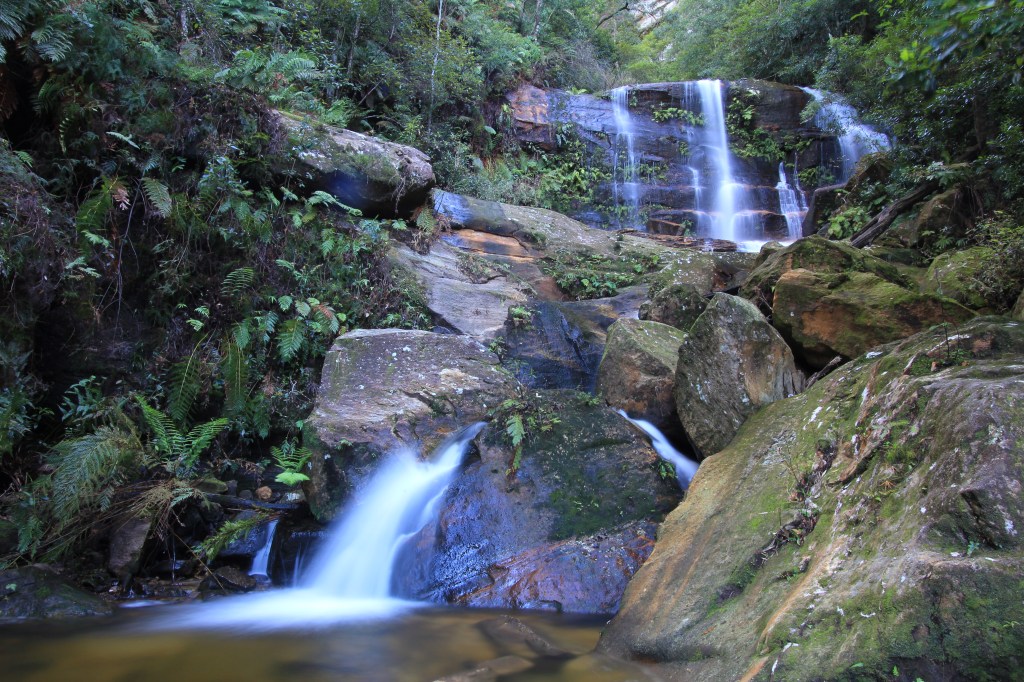
Lodore Falls, a jumble of rocks and water with its own unruly charm.
I went
further down the valley but I cannot locate my photos of the two lower falls.
If I come across them I’ll definitely inflict them on you! And, as always in
Australia, best after rain.
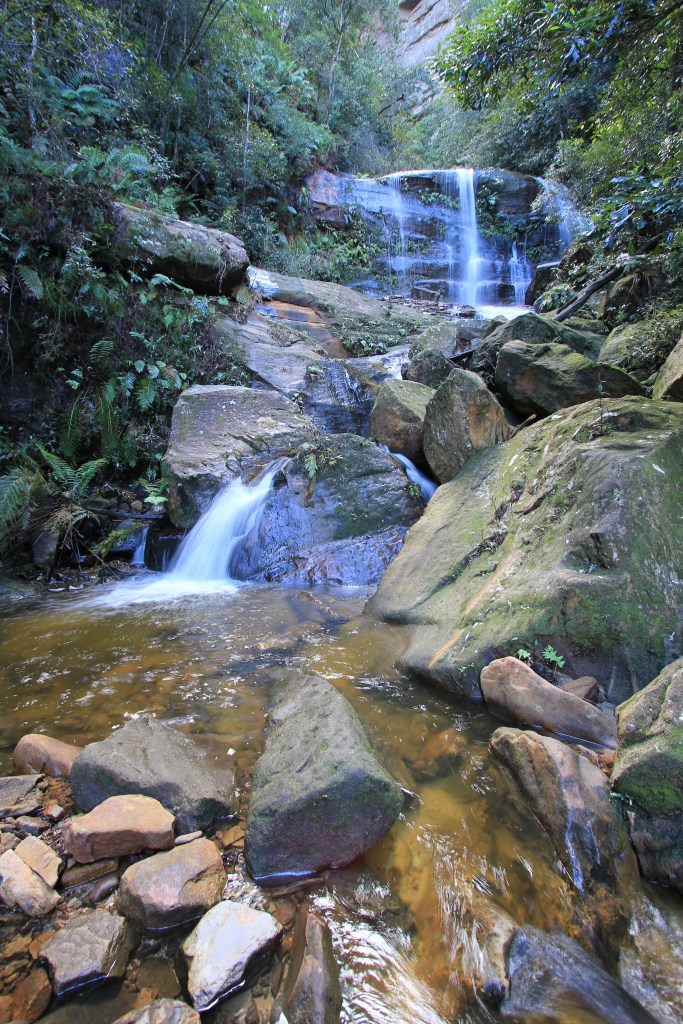
The falls, the pool, the rocks, the forest, the silence.
I’ve spent decades
deliberately immersing myself in amazing art. Have I discovered the key, the
single formula that turns a mediocre talent such as mine into a world-shaping
artist?
No.
But I can see something over there, in the distance, just beyond the horizon. The knowledge of a state, a place I could be, maybe, one day – a place great artists occasionally reach and, very rarely, in which they learn to dwell. I can see it, dammit!
I think of
it as the ‘flambouyant Elton John in the early 1970s’ place. Having absorbed
all the standard musical influences, he tapped into something within, something
of himself (probably his sexuality), struggled to bring it out, and produced
music that became an identifiable sound, the cultural marker of that time and
place. (I think he lost it when he settled on a formula.) Or the Aretha
Franklin place. As far as I can tell, she got there young and never left it.
I can see the place but, as you can tell, I can’t really describe it. The nearest I’ve got is that it’s a place of letting go. Finding a space in your life where you discover a motivation for doing things that is not to ‘please others’.
It’s a place of letting go of others’ regard. This is so hard for me, a person who at heart lives for the regard of others. I want to be liked, I want to please, to be acclaimed, to make people happy. I suspect it’s really difficult to make something truly meaningful under such conditions. I haven’t managed it.
It’s hard to perform when you’re being watched.
Being Watched: artwork from the cover of Jean-Michel Jarre’s ‘Equinoxe’
The place of letting go is a tricky place to find because, if you make anything for public consumption, at some level you must care about how people will react. I guess it’s a matter of degree.
Kylie says it’s akin to the notion of being cool. Being cool (she says) is not caring whether you’re cool or not.
Best I can do is tap into the raw power of others and, using my instructional voice, transmute it into something lesser, something Russell-flavoured. My work is more derivative than I’d like, and at every stage in the editing process it runs the risk of being further smoothed into something I think my target audience might want. I’m a consummate mimic, able to replicate the rhythms and feel of greater women and men.
Maybe I’m
being too hard on myself. There was one point at which I genuinely created new
art, art that helped shape New Zealand’s identity. You see, I found a substance
that suspended my desire to please, my preoccupation with regulations, my fear
of breaking the rules that turns my art (and most people’s art) into riskless,
derivative mush. It’s a wonderful substance, dark and addictive. No, not drugs,
though that’s worked for many artists. I’m talking about anger.
In 1991,
while finishing my PhD, I was headhunted by the New Zealand government’s
Department of Internal Affairs to work on a sesquicentennial historical atlas
of New Zealand. This project was wonderful, my part marred by my struggles with
organised religion and an awakening sense of social justice, but at the end we
produced a superb atlas. My primary role was the creation of the first draft of
the cartography, which the government’s cartographers fancied up. The system
worked well. Then, at the very end, I got a phone call to tell me that the
project still owed the government cartographers $30,000, and they had proposed
a deal that the debt would be waived if my name and that of a cartographic
co-collaborator were taken off the Atlas, allowing the government agency to
take all the credit.
I doubt
I’ve ever been as angry as I was that afternoon. I can still remember the
feeling. It hurled me through the next two years of fourteen hour days,
seven-day weeks, producing my own contemporary atlas to stand beside the
historical atlas, to be a testament to the unique cartographic vision I felt
had been stolen from me. My anger caused me to discard convention, to
experiment, to embrace cartographic form and content never seen in a national
atlas (and still never replicated). I succeeded. The atlas, first published in
1999, sold 50,000 copies, was a finalist in the Montana Book Awards and
received strong critical reviews.
At this
point I must put my hand up and admit that it took a toll. Anger is a demanding
partner: he motivates, but he drives up your blood pressure and diminishes your
ability to function as a rational adult. It’s a fool’s bargain, but it’s done
now. I said what I wanted to say, and with that book reclaimed my cartography
from the thieves working for the government.
I’m trying
to find another road to that place of letting go. I care far too much about
what people think, to the point I end up paralysed, unable to move forward with
my writing. This latest novel has taken twelve years and only occasionally have
I been able to find the creative place. Sure, I can sit down and write, but
there in my head is the voice I dread. You can’t say that. No-one will publish
that. Stick to the rules, follow the formula.
I have a
novel I want to write. It has a powerful message, a message that will make an
important contribution to New Zealand and beyond. I’m the only one who can
write it. It’s been in my head for twenty-five years. I can see it. But as yet
I haven’t found the – something, courage? I don’t know – ability to let go and
write the damn thing. I fear I will not do it justice. I need to stop being so
nice, so rule-conforming, so socialised, carve out six months of bloody-minded
selfishness and see what happens.












 insanemapboy