
It is a belief held by most authors that there are two types of novelists: plotters and pantsers. A google search of these terms unearths dozens of writing advice sites explaining that writers either plot their novels in advance or just wing it, trusting their memory or serendipity to weave it all together at the end.
My first fantasy trilogy, Fire of Heaven, was meticulously plotted. I knew at what time of what day each character would be in a certain location. This allowed me to tell a complex story but it also straitjacketed my characters, as I could not allow them to veer off script. The result was a complex world but rather stiff characterisations.
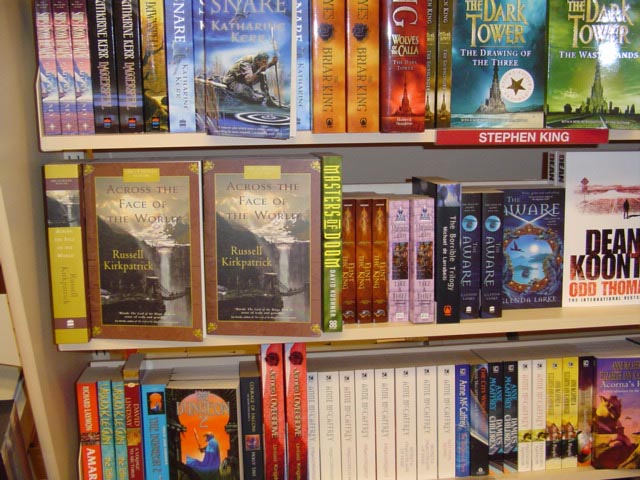
In an attempt to break out of Plotter’s Jail I wrote my second trilogy (Husk / Broken Man) by the seat of my pants. I constructed half a dozen character sketches and set them off like wind-up toys to walk through half a million words to a destination of which I had only the haziest notion. This worked better, I think, but it also caused problems, to the extent that a secondary character went missing for a whole novel. I plain forgot about him.
I’ve decided to become a third type of writer. From now on I’m going to write in reverse. Rather than starting at the beginning and working through to the end by either plotting or pantsing, I’m going to start by writing a detailed account of the novel’s ending. Then I’ll sit down and work out what my characters need (what experiences, what moral attributes, what abilities, what relationships, what flaws) to make that ending work. After that I’ll work backwards through the story to give each character the things they need. In other words, before my characters get to make their metaphorical journey, I’ll travel that journey in reverse.
(Of course, this is just another form of plotting, just backwards. Shh.)
This idea comes from having just finished re-reading Lois McMaster Bujold’s body of work. She is the most awarded sci-fi and fantasy writer you’ve probably never heard of. This is because most of her books have never been sold into Australia or New Zealand. I’m not sure why no-one picked them up here, because her books are uniformly excellent, with The Curse of Chalion my favourite fantasy novel. She’s won four Hugo awards for best novel, one for best novella and two more for best series (The Vorkosigan series in 2017 and the Chalion series in 2018).
The climaxes of her novels are glorious intersections of moral dilemmas, weaknesses and strengths, abilities used in unexpected ways, worldbuilding suddenly made relevant and successes and failures of the human spirit. I began wondering how she manages time and again to make them feel so organic, so likely. Re-reading The Curse of Chalion gave me a clue: when her protagonist begins to see how the pattern of his life has shaped him into the man for the crisis, he wonders “How long have I been walking down this road?” The gods – and the author – have aimed him towards the novel’s climax, harvesting the physical, social, moral and spiritual lessons along the way to use at the end. Thus we have the satisfying conclusion where a protagonist overcomes his foe not through violence (come on, enough of the punching) but through cleverness and humility. And not just his own, but also the supporting characters who lend him timely advice, wisdom and moral support.
To get to the end, I’m going to start from the end and work my way back to the beginning. I’ll let you know how it goes.
 insanemapboy
Leave a comment